

I was actually humming and hawing about doing this article, because I’m fully aware that encouraging some people (not all people, but some) to be mentally strong can backfire.
Some people can take it on the chin, whereas others take it personally, and it can get them down.
So, to clarify:
In this article, when I’m encouraging someone to be mentally strong, I am not attacking that person.
I am not saying that this person is broken or anything like that. In fact, I’d argue that in order to live a beautiful life, you need to experience both the lows and the highs.
You could call it a “full contrast” life.
And I believe I’m fully qualified to be writing this article, because in my own personal life I’ve had plenty of lows.
So let’s talk about this in more detail.
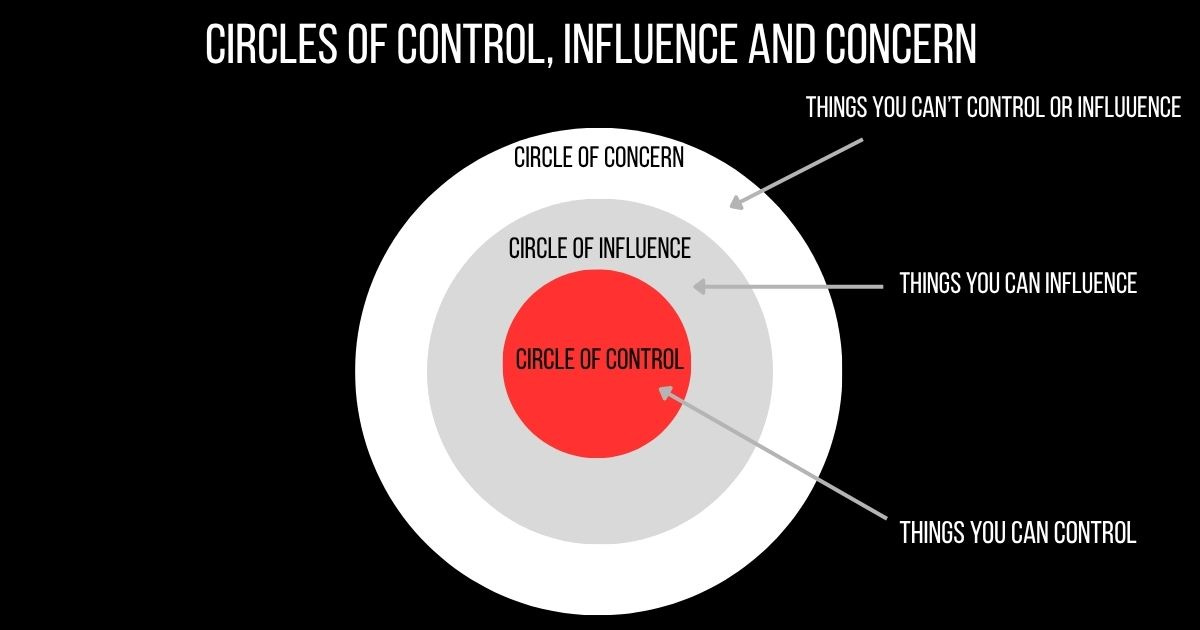
#1 Accept What You Can’t Control
What you’ll tend to find is that a large part of human suffering comes from people trying to control things that are essentially outside of their control.
Mentally strong people on the other hand, do the opposite and tend to focus on the things within their control (see image above).
So let’s discuss some things that are outside of your control.
The first one is the weather. Whether it’s sunny, raining, or snowing outside, there’s nothing you can do about it.
In fact, the only thing you can do is adapt to it.
The opinions of others is another one. Yes, you can treat people with love, kindness, and respect and do the best that you can, but ultimately, you cannot control what people think about you.
The economy is another one. There’s not much you can do there.
Your past is another. What’s happened in the past has happened, and there’s nothing you can do to change it.
And if you’re a content creator, you’ve probably learned this through personal experience:
You cannot control the algorithm. It is outside of your control.
So you know what the sane, rational thing to do is?
It’s to not focus on those things and to focus on the things within your control.
And this leads me perfectly on to the next point.

#2 Protect Your Basics
I don’t care how mentally strong you are:
If your basics aren’t protected and managed, everything else becomes more difficult, and that includes emotional regulation.
So what are the basics?
The basics are sleep, nutrition, physical exercise, and stress management.
Let’s quickly run over those things.
The first one is sleep, and it is number one for a reason, because it is the foundation of health.
When your sleep is dialed in, meaning you’re getting the right amount of sleep and you’re also going to bed at the same time and waking up at the same time each day, it makes everything else easier.
You are just a better human being when your sleep is dialed in.
Protect it.
The second one is nutrition. The majority of the time, you need to be consuming whole, natural foods, and the diet needs to be high in protein.
When I say this, I’m not saying you can never enjoy yourself, that you can never have cake, ice cream, or pizza.
Of course you can have those things, but the majority of the time it’s whole natural foods.
The third thing is physical exercise. Physical exercise is so important because it’s not only good for your physical health but also for your mental health, which is obviously good for emotional regulation.
And the thing is, with physical exercise, this can be really simple:
Two to three days a week of full-body workouts in the gym, combined with daily walks.
When we’re talking daily walks, that’s roughly 7,000 to 10,000 steps per day. Like I said, it can be kept as simple as possible.
Finally, we have stress management. If you’re doing all of the things I’ve just mentioned, this will help de-stress you, but stress management is also about spending time with the right people and being in the right environment.
For you to function at your best, you need to protect your basics.

#3 Feel Your Emotions Instead of Fighting Them
Mental strength isn’t about suppressing your emotions. It’s about allowing yourself to feel them and then choosing how to act.
In other words, you don’t fight them, and you don’t push them away. You surrender to them.
You allow yourself to feel them.
The analogy that perfectly describes this is that your emotions are like the weather inside of you.
And when it comes to the weather, you can’t change it, so you surrender to it.
For example, when it’s raining outside, you don’t try to change it. You put on a raincoat or grab an umbrella.
You adapt.
It’s the same when it’s sunny:
Again, you can’t change it, so you put on your shorts and adapt.
If it’s snowing, your winter jacket comes on. Again, you don’t change it.
Your emotions work exactly the same way. You surrender to them, you allow yourself to feel them, and you don’t suppress them.
#4 Set Boundaries
Saying no is a strength. Let me repeat that:
Saying no is a strength.
The way I like to put it is that nobody can pour from an empty cup. For you to be of service to other people, your cup needs to be adequately filled.
In other words, to be selfless, you first need to be selfish.
So don’t feel guilty for wanting “me time.” Tell people no if that’s the best thing to do.
Stop overcommitting, and stop people-pleasing, because eventually it will wear you down.
It is okay to put your needs first.
In numerous articles on this website, I’ve said that the most important relationship is the one with yourself.
It’s not the one with your spouse. It’s not the one with your kids and it’s not the one with your boss.
It’s the relationship with yourself.

#5 Do Hard Things on Purpose, in Doses You Can Absorb
A little bit of stress in moderation is actually good for you, and this is why, from a mental toughness perspective, you need to be doing things that challenge you.
The key here, right, is to do it in doses that you can absorb, because too much stress for too long a period of time won’t build you up. It will damage you.
So when it comes to stress exposure, think small doses, think recovery, think doing it again.
A good example of this is strength training. When you go to the gym and lift weights, you are stressing the muscle tissue, and what generally happens, if recovery is dialed in, is that the muscle will grow back bigger and stronger.
That way, the muscle is better able to handle it next time.
In other words, it adapts.
In nature, it’s the same. Roots and branches grow strong on trees because they’ve been exposed to the wind.
They’ve been exposed to resistance.
Trees that have grown up in sheltered environments tend to grow fast, but then they collapse under their own weight, because they haven’t built that strong wood, so to speak.
They haven’t been exposed to the wind, which in turn makes it stronger.
The way I like to put it is:
You do not build mental toughness by wrapping yourself in bubble wrap and lying in bed all day.
You build mental toughness by exposing yourself to a little bit of stress and recovering from it.
And this could be as simple as taking a cold shower for 20 to 30 seconds after reading this article.