

So, for those that don’t know, unilateral exercises are basically exercises where you train one arm or one leg at a time.
That’s the easiest way to describe it.
And to be fair, when it comes to the upper body, you’ll often see guys doing unilateral exercises.
For example, a single-arm dumbbell row is a unilateral exercise, a single-arm horizontal press is a unilateral exercise, and a single-arm overhead press is again a unilateral exercise.
So the upper body isn’t a problem.
It’s when it comes to the lower body that you rarely see guys doing unilateral exercises
But I’d actually argue that’s where most of the benefits of unilateral training come from.
And this is why I’ve written this article because if you understand the benefits of unilateral exercises, it might just encourage you, next time you’re at the gym to actually do them.
So let’s get into it.
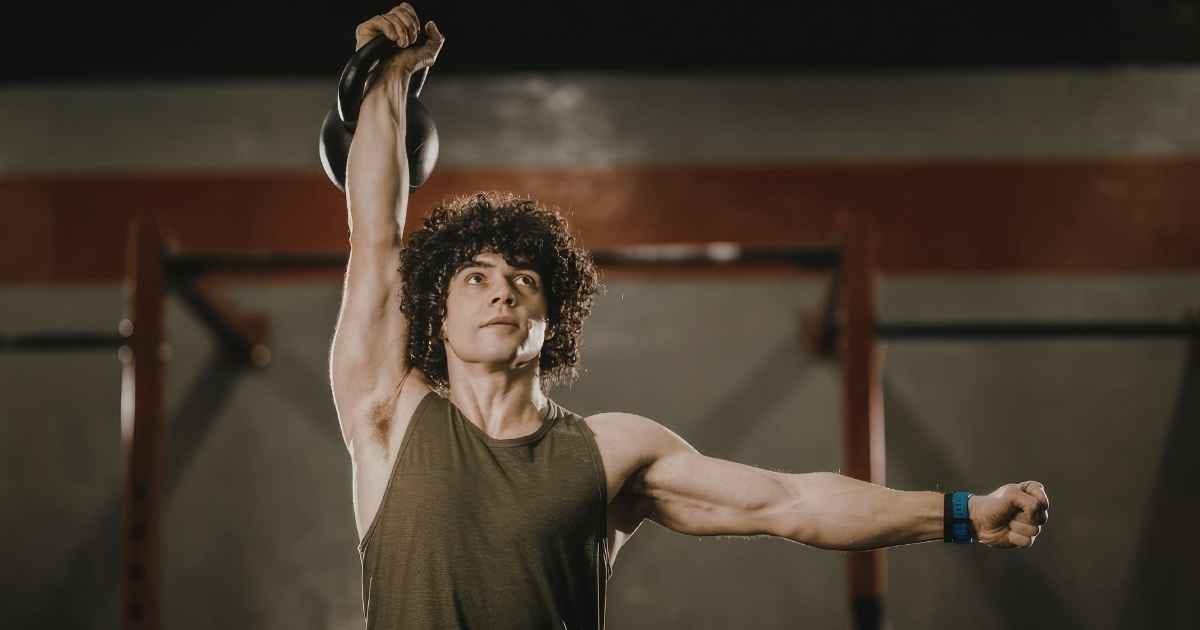
#1 Unilateral Training Fixes Imbalances
This is probably the benefit that’s going to appeal to most people, and that is unilateral training corrects muscle imbalances.
You could say it irons out weaknesses.
I’ll explain how it works.
You see, one of the problems with barbell training—even though barbell training is so good for developing strength—is that it allows the stronger side to take over.
Every single one of us has a more dominant side, whether that’s the right side or the left side.
But unilateral training doesn’t offer you that luxury, because you’re holding a kettlebell or a dumbbell or whatever tool you’re using with each arm separately (see image above).
And to use an example let’s say, you can overhead press a 20kg kettlebell for ten reps on your right arm, but when you go to your left arm you can only do eight reps because the left side isn’t as strong.
Well, now you’ve just exposed a weakness—and because you’re aware of that weakness, you can train the left arm a little bit more so it catches up with the right arm.
So do you see what I mean when I say it irons out weaknesses?
This is a huge, huge benefit of unilateral training.
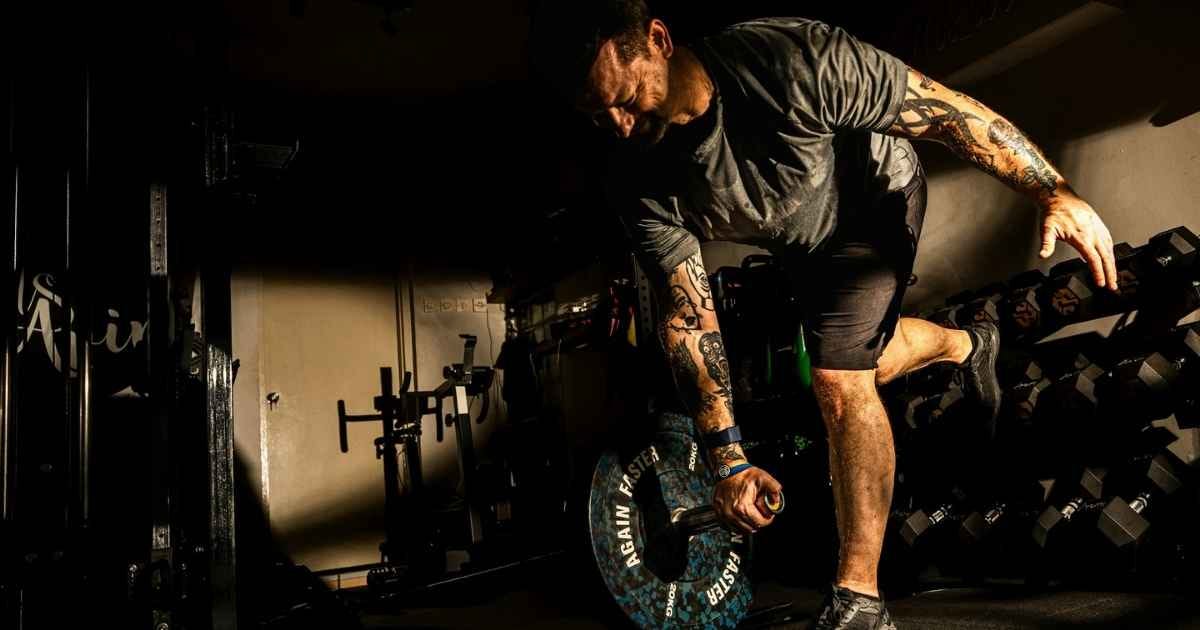
#2 Unilateral Training Improves Stability
This is a huge benefit right here and probably my own personal favourite, and that is unilateral exercises expose stability issues in real time.
For example, it’s not uncommon to see guys squatting heavy weights but once you put them on one leg, you see them shaking, wobbling, and all over the place.
One of the reasons why is because they’ve rarely done single-leg exercises; they’ve always done exercises where they’re on two legs.
The analogy that I like to use, which explains this perfectly, is that you could spend loads and loads of money on a house but if the foundations are weak, it doesn’t matter how much money you spend on top.
Because once the weather gets nasty and once the weather changes, it’s only a matter of time before the house comes crumbling down.
Well, unilateral exercises especially lower-body exercises — are the foundations.
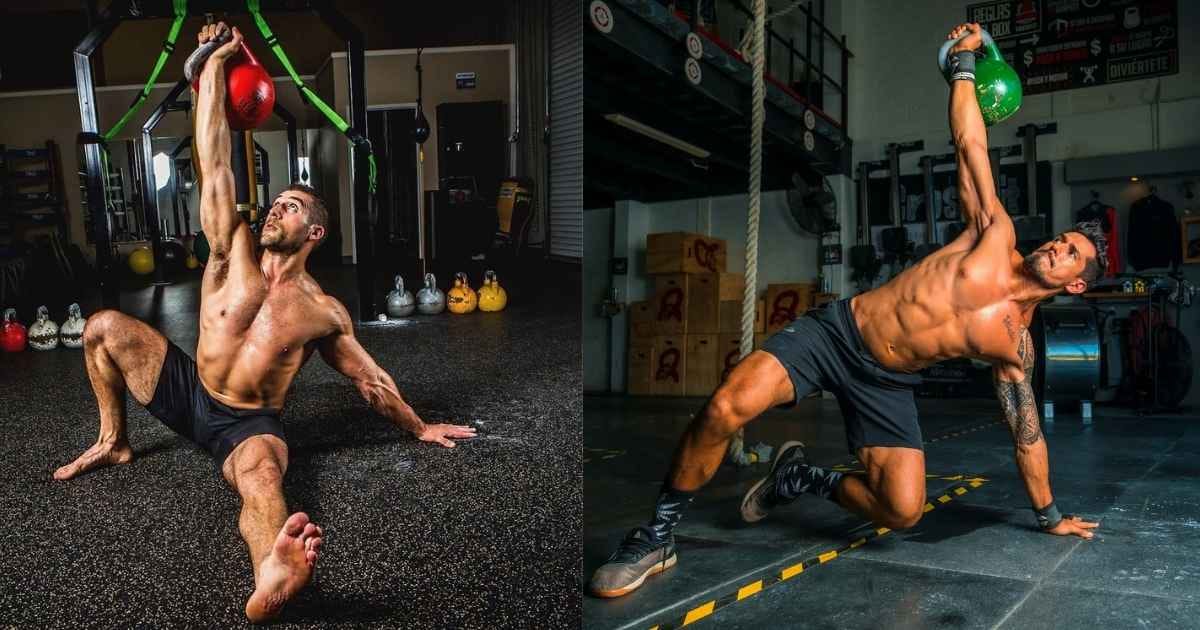
#3 Unilateral Training Improves Core Strength
This really ties into the previous point, but it deserves a section of its own.
When you go unilateral — whether that’s one arm or one leg — your core has to fire in order to stay balanced and stable.
For example, anyone who’s ever done a single-arm farmer’s walk will tell you, they have to consciously keep their core nice and tight.
You could say the mind-muscle connection is on a different level.
The same thing happens when you do a Turkish get up (see image above) it’s essential that you keep your core nice and tight.
It’s exactly the same when doing a single arm overhead presses (see image #1) core engagement is key.
As I said earlier, when you go unilateral the mind-muscle connection is on another level because it requires more stabilization.

#4 Unilateral Exercises Makes You More Athletic
I've already done an article on the benefits of training like an athlete, and if you want to learn more click this link and give it a read.
Anyway, there's a huge transfer to your chosen sport when you do unilateral exercises.
Why?
Because a lot of athletic movements have you on one leg.
Let's take running for example:
When you're running, you're switching legs—you're on one leg at a time. If you're in a combat sport and you're kicking (see image above) you're on one leg.
If you're on the field and you're cutting from side to side, you're going from one leg to the other.
Unilateral exercises like forward and reverse lunges, lateral lunges, and lateral bounds, these kinds of exercises can help you when it comes to your chosen sport.
And again, from an injury-prevention perspective, unilateral exercises are fantastic here because if you're doing these single-leg exercises in the gym, it means when you're on the field, track, or ring, you're less likely to get injured.
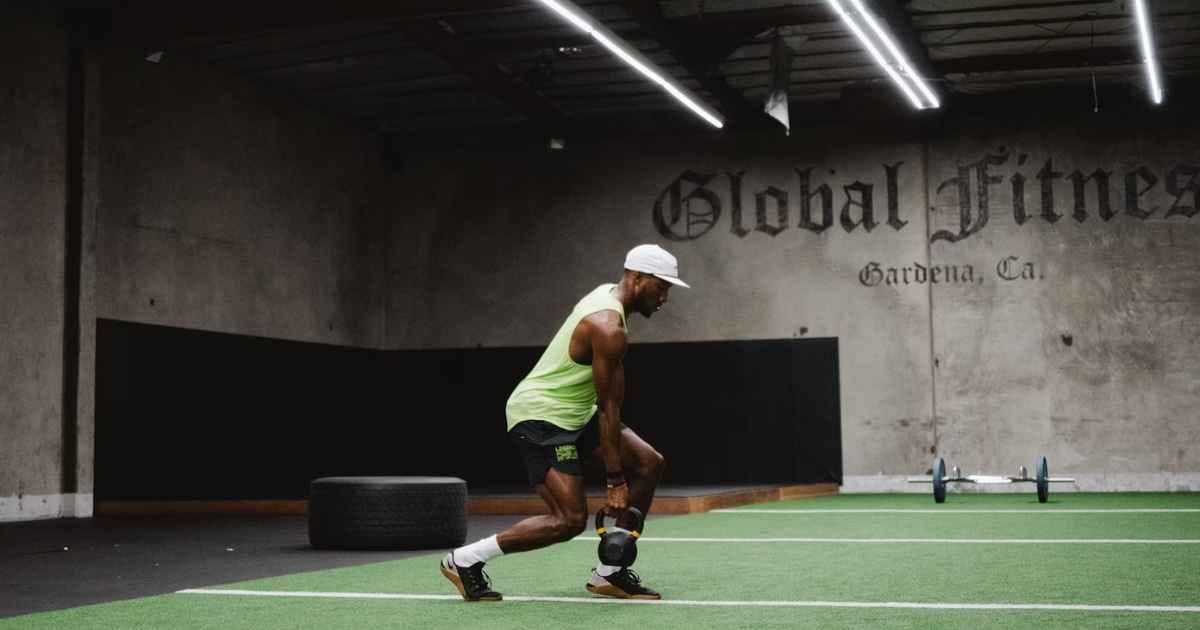
#5 Unilateral Exercises Allows You to Use Lighter Weights
Talk to seasoned gym rats and you might hear something along the lines of…
“You wanna get the maximum amount of stimulus with the lightest weight possible.”
And I actually agree with that statement.
This is smart training—and this is exactly where unilateral training comes in.
Take the example of someone who can squat 400 lbs. It’s very unlikely they’ll be able to squat that amount of weight on a single leg.
The weight has to drop dramatically, and this doesn’t always mean it’s a downgrade because unilateral work gives you better limb-to-limb symmetry (as discussed in #1) plus more stability and core demand (as discussed in #2 and #3.
These are real pros.
But at the same time this isn’t me saying you should never do bilateral exercises (working both limbs at the same time).
Because bilateral work has benefits also, especially when it comes to building raw strength.
The truth is, a good training program should include both. You don’t sleep on either of them.